Markets generate more data than investors can process alone, while emotion and delayed decisions can weaken performance. Quant hedge funds tackle this problem with mathematical models, algorithms, and automated analysis. In this article, we will explain how they work, the strategies they use, their benefits, risks, and how they differ from traditional funds.
Table of Contents
A quantitative fund, or quant fund, is an investment fund that uses mathematical models, statistical analysis, and computer algorithms to guide investment decisions. Instead of relying mainly on a manager’s intuition, it follows predefined rules to analyze data, identify opportunities, build portfolios, and execute trades.
Quantitative methods can be applied across equities, bonds, currencies, commodities, and derivatives. They may also use fundamental information, such as earnings, valuations, and balance-sheet data, by converting it into measurable inputs that can be compared across many assets.
Algorithms are central to quantitative investing because they can process large amounts of data, apply rules consistently, and react faster than manual analysis. Even so, they do not replace people entirely. Human teams still design, test, monitor, and refine the models, while portfolio managers oversee risk and capital allocation.
In investing, quantitative means using measurable data and statistical relationships to support decisions. Quantitative teams may study prices, trading volume, earnings, interest rates, volatility, and economic indicators to identify patterns that could help forecast market behavior.
Researchers then turn these ideas into mathematical rules and test them against historical data through backtesting. The goal is not simply to find patterns, but to determine whether they are meaningful, repeatable, and strong enough to remain useful after transaction costs and other real-world limitations.
Quantitative investing can be used across several investment structures:
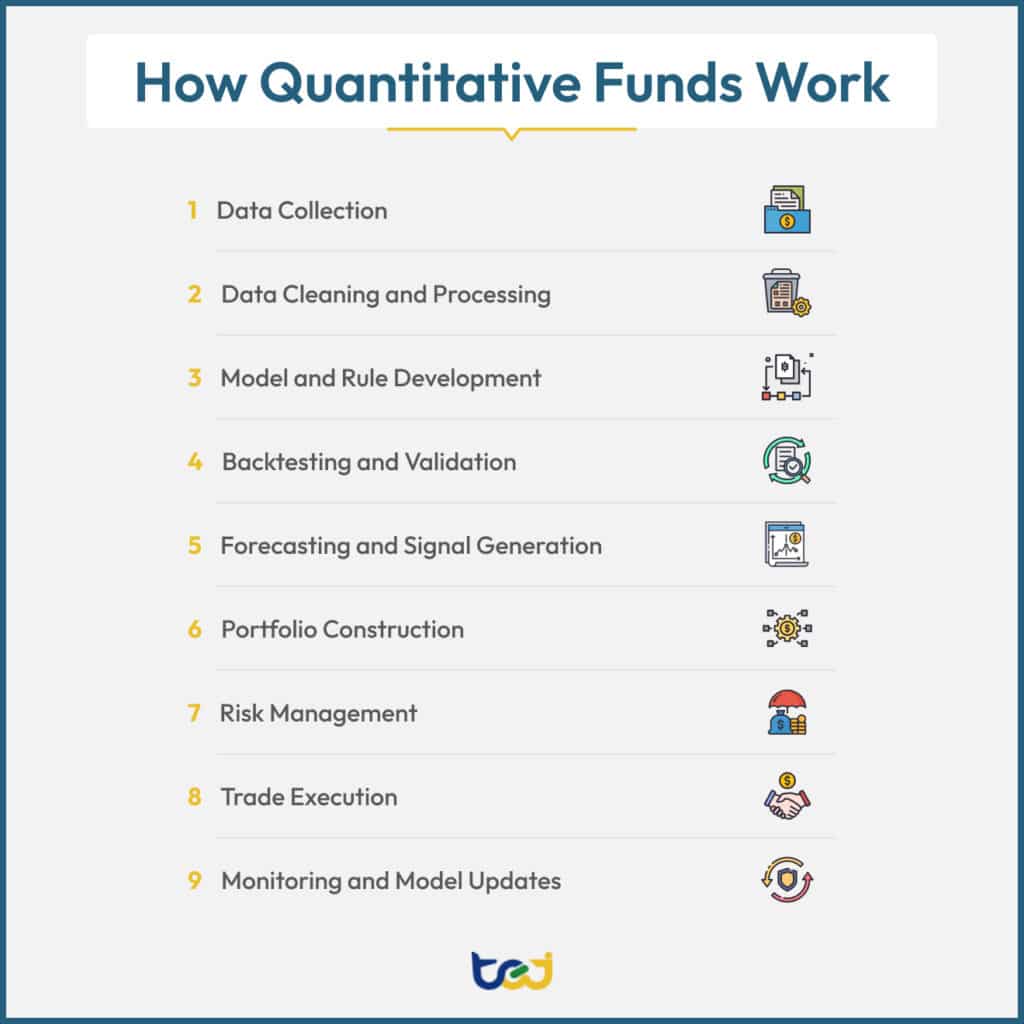
Quantitative funds follow a structured workflow that turns raw information into portfolio decisions and executed trades. Although the exact process varies by fund, it generally moves through the following stages.
Read more: TEJ Quantitative Investment Database
Quantitative funds do not rely on a single formula. Instead, they use different models to capture opportunities across markets, from trends that last several months to price gaps that disappear within milliseconds.
A successful quantitative idea can sometimes be adapted across assets or timeframes. For example, a mean-reversion model designed for equities may be modified for currencies or commodity spreads. Larger funds often run multiple strategies together so that performance does not depend on a single type of market opportunity.
Read more: Factor Library – Taiwan’s Factor Dataset for Quantitative Investing
What makes quantitative funds appealing is their ability to turn vast amounts of data into faster, more disciplined investment decisions. By combining automation with clear rules, they can reduce emotional bias, scan more opportunities, and manage large portfolios with greater consistency.
The same automation and complexity that give quantitative funds their advantages can also create significant risks. Models remain dependent on the data, assumptions, and market relationships on which they were built.
Learn more about TEJ Point-in-Time Audited Financial Database – Rejecting “Peek-ahead” Backtesting!
Quantitative funds may suit investors who prefer a rules-based investment approach and are comfortable relying on models rather than the judgment of a single fund manager. However, the right option depends heavily on the fund structure, strategy, risk level, and degree of transparency.
The main difference between traditional and quantitative funds is how they identify investments and turn those ideas into trades. Traditional funds rely mainly on fundamental research and portfolio-manager judgment, while quantitative funds convert market information into rules that can be tested and applied systematically.
Traditional fund analysts study individual companies by reviewing financial statements, speaking with management, evaluating industries, and estimating future business performance. Portfolio managers then decide which investment ideas to include in the portfolio.
Quantitative teams approach research differently. They examine large datasets, search for measurable relationships, and translate those findings into statistical models. Portfolio managers generally focus less on selecting individual securities and more on approving models, allocating capital, and overseeing portfolio-level risk.
Traditional funds usually concentrate on a manageable number of companies within a particular sector, market, or region. Their investment decisions may take longer because each idea requires detailed human research.
Quantitative funds can evaluate thousands of securities and signals at the same time. Depending on the strategy, models may use market prices, company fundamentals, economic indicators, or real-time information. Automated systems can also respond and execute trades faster, although not every quant fund operates at high-frequency speeds.
Traditional funds often hold investments for longer periods, particularly when their strategy is based on a company’s long-term business prospects. Quantitative funds may trade more frequently as new signals appear, which can increase transaction costs, market impact, and taxable events.
Quant funds may use fewer traditional research analysts, but this does not always make them cheaper. Savings in manual research can be offset by spending on data, computing infrastructure, software, and specialized technical teams.
Traditional managers can adjust their views when new qualitative information emerges, but their decisions may be influenced by personal judgment. Quantitative models apply rules consistently and can sometimes be adapted across different markets or asset classes. However, they must be monitored and updated when market relationships change.
Traditional funds can usually explain an investment through a clear business or valuation thesis. Quantitative funds may be less transparent because their models are complex and often protected as proprietary systems.
Traditional funds are more exposed to poor judgment, emotional bias, and excessive dependence on an individual manager’s ability. Quantitative funds are more exposed to model errors, weak data, overfitting, and market conditions that differ from their historical assumptions.
Neither approach is automatically superior. Their effectiveness depends on the quality of the research process, portfolio construction, risk controls, and execution.
| Feature | Traditional Funds | Quantitative Funds |
| Primary approach | Fundamental research and human judgment | Statistical models and systematic rules |
| Investment selection | Analysts evaluate individual companies or assets | Models rank or select assets using measurable signals |
| Portfolio manager’s role | Reviews ideas and makes individual investment decisions | Selects models, allocates capital, and oversees risk |
| Main data sources | Financial reports, industry research, and management discussions | Market, fundamental, economic, and alternative datasets |
| Speed | Limited by the pace of human research and decision-making | Can analyze data and execute decisions rapidly |
| Scale | Usually covers a focused group of securities | Can monitor thousands of assets and signals |
| Holding period | Often medium- to long-term | Ranges from milliseconds to several months |
| Portfolio turnover | Generally lower, depending on the strategy | Often higher, but varies widely by model |
| Adaptability | Managers can respond to qualitative changes | Models can be updated or adapted across markets |
| Transparency | Investment reasoning is often easier to explain | Proprietary models may be difficult for investors to understand |
| Cost structure | More spending on analysts and company research | More spending on data, technology, and technical talent |
| Main risk | Human bias and manager error | Model, data, and overfitting risk |
No. A quant fund is any investment fund that uses mathematical models and systematic rules. A hedge fund is a legal and investment structure that may use many different strategies. Quantitative hedge funds are therefore one type of quant fund, but many quant funds are mutual funds or ETFs.
A quantitative hedge fund is a privately managed quantitative fund that uses statistical models, algorithms, and automated systems to identify and trade investment opportunities. It may invest across stocks, bonds, currencies, commodities, or derivatives and can also use leverage, short selling, and complex strategies to pursue absolute returns.
No. Computers analyze data, generate signals, and may execute trades automatically, but people still design the models, select data, test strategies, set risk limits, and monitor performance. Portfolio managers and researchers may also adjust, suspend, or replace a model when market conditions change or results weaken.
Not necessarily. Risk depends on the fund’s strategy, leverage, liquidity, and controls. Quant funds face model, data, technology, and crowded-trade risks, while traditional funds are more exposed to human judgment and emotional bias. Some quantitative hedge funds can be highly risky, while diversified quantitative ETFs may be relatively moderate.
Quantitative funds may analyze prices, trading volume, volatility, company earnings, valuations, balance-sheet data, interest rates, currencies, and economic indicators. Some also use alternative data, such as news sentiment, web activity, satellite images, or transaction data, provided the information is reliable, legal, and relevant to the strategy.
Neither approach consistently performs better in every market. Quant funds may benefit from speed, discipline, and broad data analysis, while traditional managers may respond better to unusual events or qualitative changes. Performance ultimately depends on the quality of the strategy, execution, risk management, fees, and prevailing market conditions.
Quantitative funds turn financial data into systematic investment signals, helping investors test ideas, build portfolios, and execute strategies with greater consistency. However, reliable results begin with reliable inputs.
TEJ supports quantitative research with professionally collected, cleaned, and reviewed Taiwan market data covering market activity, financial accounting information, and corporate action events. Its structured datasets help researchers reduce preparation time, conduct more dependable backtests, and evaluate investment factors using consistent historical information. Build stronger models with data designed for serious financial analysis.
Contact us and explore the TEJ Quantitative Investment Database to support your next quantitative investment strategy today!