

Preface
TCRI Watchdog (WD) converts complex news and announcements into standardized quantitative alternative data. Building on our research into “Official Announcements (Source P)” and “Media News (Source N),” we have confirmed that disclosure channels directly dictate the speed and structure of market digestion.
This chapter moves from macro “Event Categories” to micro “Source × Sub-category” dimensions to capture actionable Alpha within granular events. Focusing on high-sensitivity “Corporate Control Events,” we analyze the signal heterogeneity between Source P and Source N. We further demonstrate how these high-precision signals assist investors in optimizing entry timing and hedging strategies.
Backtesting Framework
This study adopts a standard event study methodology to evaluate abnormal returns (AR) and cumulative abnormal returns (CAAR) surrounding event occurrences.
Research Scope and Event Design
- Market coverage: Taiwan-listed and OTC companies (including delisted firms)
- Data Source: TCRI Watchdog (WD), focusing on both announcement-based (P) and news-based (N) events
- Sample period: January 1, 2018 to August 31, 2025
- Research Scope (Source × Subcategory):This chapter focuses on 2 representative event groups selected based on CAAR performance and statistical significance, covering both positive and negative signals:
- P-MO: Corporate governance announcements — control / agency issues
- N-MO: News — control / agency issues
- Event grouping: Based on the WD event scoring system, events are grouped as follows:
| Group | Event Score |
|---|---|
| negative | <0 |
| -1 | =-1 |
| -2 | =-2 |
| -3 | =-3 |
| positive | >0 |
| 1 | =1 |
| 2 | =2 |
| 3 | =3 |
| neutral | =0 |
- Event Study Design
- Estimation Window:t-270 ~ t-21
- Gap Days:10 days
- Event Window: t-10 to t+30
The post-event window is extended to +30 days to better capture signal persistence and tradability.
Event Categories and Backtesting Results
Compared to the previous chapter’s aggregate analysis at the category level, this section further decomposes events into specific subcategories to identify how different information sources and event types affect market reactions.
The analytical approach is adaptive:
- When subcategories exhibit consistent return directions, results are aggregated to preserve both sample size and statistical robustness
- When subcategories show heterogeneous behavior, the analysis focuses on representative and predictive subgroups to enhance precision
Based on this framework, 2 representative event groups are examined across governance, fundamentals, and capital structure dimensions.
P-MO: Announcement-Based Governance Events (Agency Issues)
P-MO events originate from material disclosures (P), including ownership changes, control transfers, and governance disputes.
These disclosures are released via the MOPS system, including both mandatory regulatory filings and exchange- or firm-initiated announcements, characterized by high standardization and rapid information transmission.
Based on this principle, this study focuses on four representative event combinations across three major dimensions—corporate governance, fundamentals, and capital structure—to analyze their individual impacts on stock price performance.
This group consists of seven subcategories:
| Subcategory | Description |
|---|---|
| MO01 | Insider / major shareholder share transfers |
| MO02 | Waiver of subscription rights |
| MO03 | Insufficient insider shareholding |
| MO04 | External intervention / control disputes |
| MO05 | Control transfer |
| MO06 | Share pledging |
| MO07 | Financial distress of insiders / major shareholders |
Event Distribution
Figure 1 presents the distribution of event scores. A total of 849 events are observed:
- Negative: 52.8%
- Neutral: 42.9%
- Positive: 4.4%
Figure 1:Event Sample Distribution (P-MO)
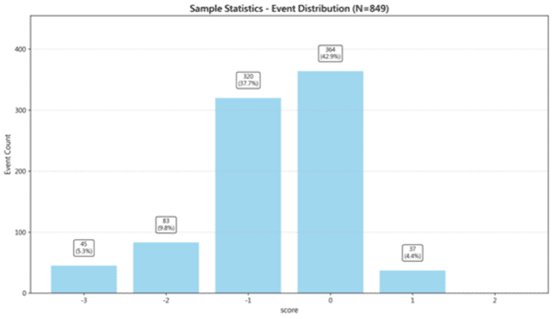
Table 2:Detailed Statistical Results (P-MO)
| Group | Event Count | Mean AAR (%) | Final CAAR (%) |
|---|---|---|---|
| 1 | 37 | 0.50 | +19.05*** |
| positive | 37 | 0.50 | +19.05*** |
| neutral | 364 | 0.12 | +4.64*** |
| negative | 448 | −0.06 | −2.41** |
| −1 | 320 | −0.10 | −4.03*** |
| −2 | 83 | 0.03 | +1.27 |
| −3 | 45 | 0.03 | +1.16 |
CAAR Analysis
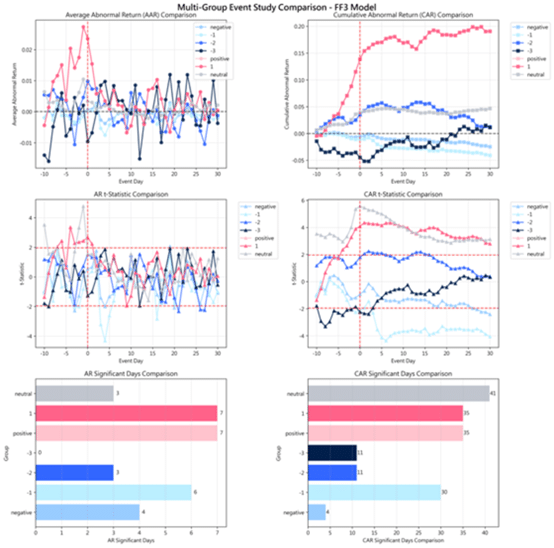
CAAR patterns exhibit clear directional separation, indicating strong discriminatory power of event intensity.
- Positive events show significant cumulative gains
- Negative events exhibit persistent downward trends
Figure 3:CAAR Group Comparison Chart (P-MO)
Effect Decomposition
Market reactions differ by group:
- Positive and neutral events are partially anticipated (pre-event reaction)
- Negative events are primarily post-event driven, indicating delayed pricing of governance risks
Table 4:Effect Distribution Table (P-MO)
| Group | CAAR(t−1)% | CAAR(t=0)% | CAAR(t+30)% | AAR(t−1)% | AAR(t=0)% | Pre% | t=0% | Post% | Post-Ret% |
|---|---|---|---|---|---|---|---|---|---|
| 1 | 11.52 | 13.86 | +19.05 | 2.72 | 2.34 | 60.5 | 12.3 | 27.2 | +5.19 |
| positive | 11.52 | 13.86 | +19.05 | 2.72 | 2.34 | 60.5 | 12.3 | 27.2 | +5.19 |
| neutral | 3.57 | 3.87 | +4.64 | 1.02 | 0.30 | 76.9 | 6.5 | 16.6 | +0.77 |
| negative | −0.62 | −0.51 | −2.41 | 0.02 | 0.11 | 25.6 | −4.5 | 78.9 | −1.90 |
| −1 | −1.07 | −1.04 | −4.03 | −0.13 | 0.02 | 26.4 | −0.5 | 74.1 | −2.99 |
| −2 | 2.53 | 3.53 | +1.27 | 0.48 | 1.00 | 199.6 | 78.7 | −178.3 | −2.26 |
| −3 | −3.50 | −4.46 | +1.16 | 0.22 | −0.96 | −301.6 | −82.8 | 484.4 | +5.62 |
Investment Implications
The positive group demonstrates strong return potential, with a total CAAR of +19.05% and post-event return of +5.19%, suggesting tradability even after disclosure. However, with 60.5% of returns realized pre-event, timing becomes critical.
The negative group shows a CAAR of −2.41%, with the −1 subgroup reaching −4.03% and post-event return of −2.99%, indicating clear post-event momentum. In contrast, the −2 and −3 groups lack sufficient statistical robustness.
N-MO: News-Based Governance Events (Agency Issues)
N-MO events share the same underlying theme as P-MO but are sourced from media reports.
Compared to official disclosures, news-driven governance events:
- May contain stronger sentiment bias
- Exhibit non-synchronized timing with announcements
- Are subject to selective reporting, often skewed toward negative events
Event Distribution
Figure 5 presents the distribution of event scores. A total of 551 events are observed:
- Neutral: 51.9%
- Negative: 44.1%
- Positive: 4.0%
Figure 5:Event Sample Distribution (N-MO)
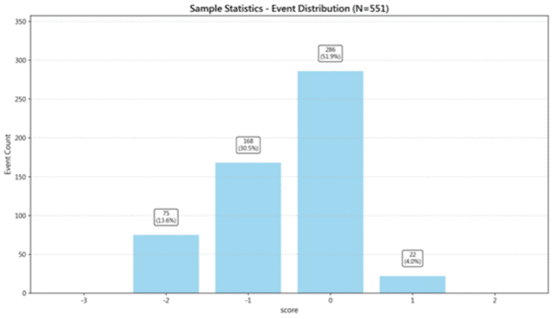
Table 6:Detailed Statistical Results (N-MO)
| Group | Event Count | Mean AAR (%) | Final CAAR (%) |
|---|---|---|---|
| 1 | 22 | 0.052 | +2.13 |
| positive | 22 | 0.052 | +2.13 |
| neutral | 286 | −0.076 | −3.10*** |
| negative | 243 | −0.118 | −4.90*** |
| −1 | 168 | −0.093 | −3.86*** |
| −2 | 75 | −0.175 | −7.17*** |
CAAR Analysis
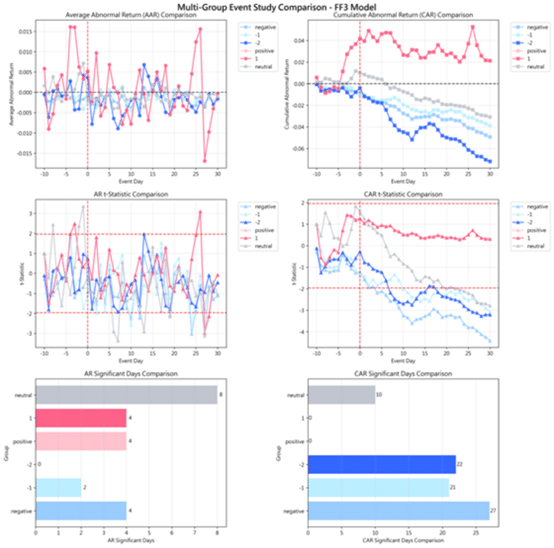
CAAR exhibits a monotonic decreasing pattern, confirming directional validity of the WD scoring system.
Notably, the neutral group shows −3.10% CAAR, in contrast to +4.64% in P-MO, highlighting systematic differences between news and announcement channels.
Figure 7:CAAR Group Comparison Chart (N-MO)
Effect Decomposition
Returns are highly concentrated post-event, indicating delayed market adjustment.
Table 8:Effect Distribution Table (N-MO)
| Group | CAAR(t−1)% | CAAR(t=0)% | CAAR(t+30)% | AAR(t−1)% | AAR(t=0)% | Pre% | t=0% | Post% | Post-Ret% |
|---|---|---|---|---|---|---|---|---|---|
| 1 | +3.67 | +4.18 | +2.13 | +0.32 | +0.51 | 172.4 | 24.1 | −96.5 | −2.05 |
| positive | +3.67 | +4.18 | +2.13 | +0.32 | +0.51 | 172.4 | 24.1 | −96.5 | −2.05 |
| neutral | +1.16 | +0.99 | −3.10 | +0.70 | −0.17 | −37.6 | 5.5 | 132.1 | −4.09 |
| negative | −0.75 | −0.79 | −4.90 | −0.14 | −0.03 | 15.4 | 0.7 | 83.9 | −4.11 |
| −1 | −0.75 | −0.97 | −3.86 | −0.40 | −0.22 | 19.4 | 5.6 | 75.0 | −2.90 |
| −2 | −0.76 | −0.39 | −7.17 | +0.43 | +0.37 | 10.6 | −5.2 | 94.6 | −6.78 |
Investment Implications
Negative events display strong and persistent downside signals:
- CAAR: −4.90%
- −2 subgroup: −7.17%
- Post-event contribution: >80%
This structure supports clear short-side trading opportunities.
Neutral events also exhibit negative bias, suggesting systematic pessimism in market interpretation of governance news. Positive signals remain statistically weak.
Conclusion
This chapter examines “Corporate Control Events” across different sources (News N vs. Announcements P). Results confirm that even for identical events, the information source significantly alters the market’s digestion path and response pace:
- Announcement-based governance events (P-MO) are largely anticipated prior to disclosure, yet still exhibit residual post-event trends
- Governance news (N-MO) tend to be interpreted negatively, with delayed market adjustment and more pronounced post-event effects
In summary, the information source dictates market digestion speed. This granular dimension helps investors find precise entry points for “early positioning,” “trend following,” and “risk hedging.”