
Table of Contents
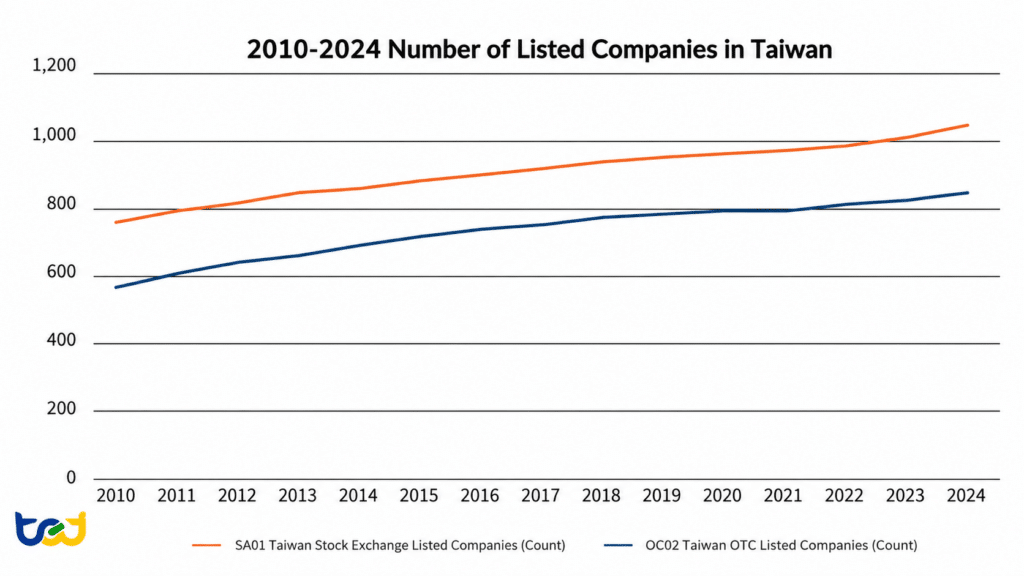
As Taiwan’s financial market continues to develop, the number of listed companies has steadily increased, reflecting the growing vitality of the local capital market and the expansion of corporate scale (Figure 1). In this context, shareholders’ meetings are not only a key part of corporate governance, but also an important focus for investors. They often involve critical information such as future business direction, dividend distribution, capital increases, and capital reductions, all of which may affect investment returns.
TEJ’s Shareholders’ Meeting Database provides comprehensive information on shareholders’ meetings of listed companies, including meeting dates, agenda items, dividend policies, and board elections. It helps investors better understand companies’ operations and future development, identify market opportunities, and make more informed investment decisions.
Figure 1. Number of Listed Companies in Taiwan, 2010–2024 , Source: TEJ Macroeconomic Database
In Taiwan, listed companies must hold shareholders’ meetings in accordance with the Company Act and the Regulations Governing the Administration of Shareholder Services of Public Companies, in order to protect shareholder rights and maintain market transparency.
Shareholders’ meetings are mainly divided into annual general meetings and extraordinary shareholders’ meetings. Annual general meetings must be held within six months after the end of each fiscal year to review financial statements, profit distribution, or loss compensation. Extraordinary meetings are held when necessary.
To confirm the shareholder roster and shareholdings, companies must suspend share transfers within 60 days before an annual general meeting and within 30 days before an extraordinary shareholders’ meeting. Shareholders who wish to participate must complete share transfer registration within the required period. Relevant regulations and timelines are shown in the figure below.
Figure 2. Extraordinary Shareholders’ Meeting Timeline
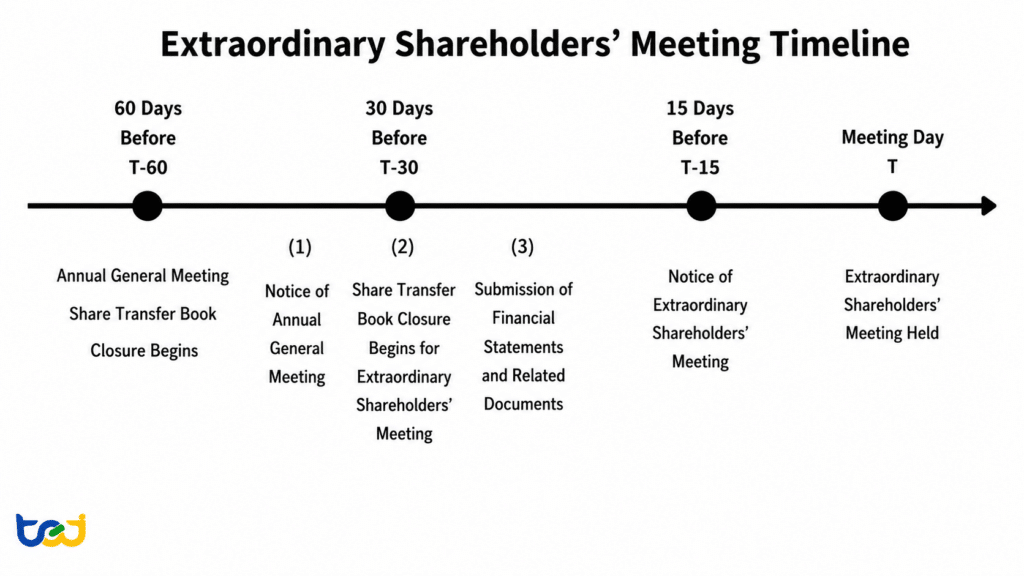
As shown in the timeline above, listed companies in Taiwan continue to release important information throughout the first half of each year. Announcements such as dividend distribution, director and supervisor elections, candidate lists, changes to shareholders’ meeting agendas, and ex-dividend dates may all affect stock prices, ETF constituent selection, directors and supervisors, and investors.
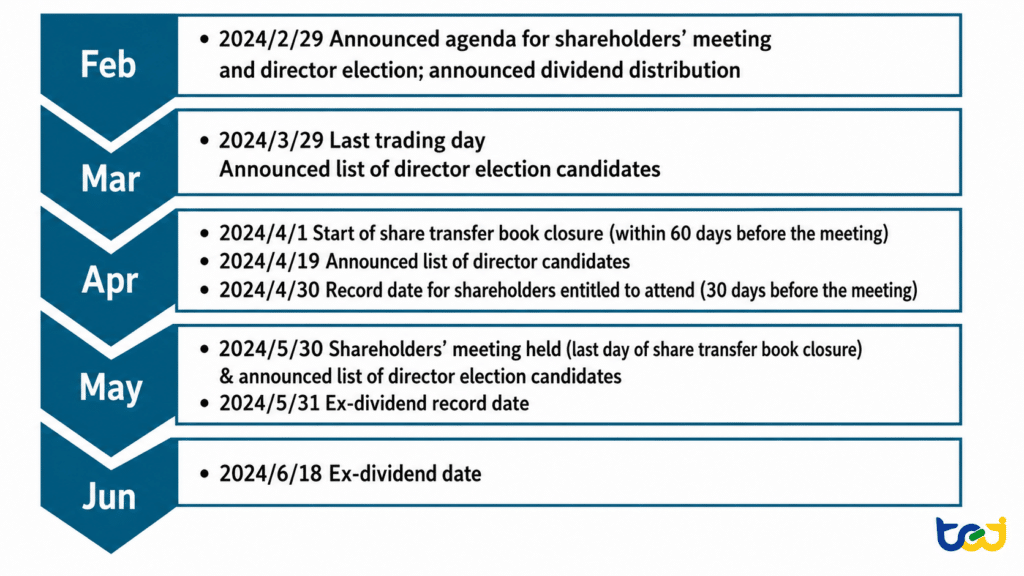
Taking Delta Electronics (2308) as an example, the company held its shareholders’ meeting on May 30, 2024. Since share transfers are suspended within 60 days before the meeting, the book closure period ran from April 1 to May 30, 2024. Shareholders were required to complete share transfer registration by March 29, 2024, in order to attend the meeting.
The figure below shows that shareholder meeting-related announcements from February to the ex-dividend period are recorded and labeled in TEJ’s Shareholders’ Meeting Database, allowing users to filter and apply the data through various fields.
Figure 3. Delta Electronics’ 2024 Shareholders’ Meeting Timeline
Market Observation Post System (MOPS) : major announcements and company filings.
Listed and OTC companies’ shareholders’ meeting dates, locations, major proposals, book closure start dates, and record dates.
1.Comprehensive data to track key resolutions : TEJ integrates shareholders’ meeting information, including meeting venue, date, director election details, dividend policy amounts, ex-dividend dates, major proposals such as capital reductions, mergers, and earnings appropriation or loss offset. This helps investors quickly understand company developments and evaluate potential risks.
2.Key dates for investment decisions : In addition to meeting dates, the database also provides key dates related to shareholders’ meeting participation and subsequent cash flows, such as book closure start dates, record dates, ex-dividend dates, and payment dates. This helps investors plan trading and cash flow arrangements, and avoid missing important events.
3.Accumulated historical data to support long-term analysis : TEJ tracks listed and OTC companies’ dividend policies, cash and stock dividend distributions, and accumulated cash dividends over different time periods, such as one year, three years, and ten years. This allows investors to compare companies’ dividend stability and long-term shareholder return performance.
Key Dates Before and After Shareholders’ Meetings
TEJ’s Shareholders’ Meeting database provides important dates before and after shareholders’ meetings, including book closure start dates, record dates, and share transfer resumption dates, helping investors monitor key shareholders’ meeting-related developments.

Table 1. Explanation of Key Shareholders’ Meeting Dates
| Item | Description |
|---|---|
| Shareholders’ Meeting Date | Date of the shareholders’ meeting or extraordinary shareholders’ meeting |
| Board Meeting Date | Date of the board meeting resolution to convene the shareholders’ meeting |
| Book Closure Start Date | Start date of the book closure period for the shareholders’ meeting, 60 days before the meeting |
| Last Book Closure Date | Last date of book closure for attending the shareholders’ meeting |
| Margin Trading Suspension Start Date | Start date of the suspension period for margin purchases and short sales |
| Margin Trading Resumption Date | Date when margin purchases and short sales resume |
| Last Day to Cover Short Positions | Last day for investors with short positions to buy back the shares |
| Ex-Rights / Ex-Dividend Date | Date for cash dividends, stock dividends, capital increase, capital reduction, and GDR ex-rights / ex-dividend adjustments |
TEJ’s Shareholders’ Meeting Database provides key information and dates related to major resolutions discussed at shareholders’ meetings, including cash capital increases, private placements, GDR issuance, and capital reductions.
STARLUX AIRLINES CO., LTD. (STARLUX AIR, 2646) held its shareholders’ meeting on June 14, 2024. The meeting approved the proposal to issue new shares through a cash capital increase before its initial public offering, allowing original shareholders to waive their preemptive subscription rights. After the shareholders’ meeting, the company proceeded with the subscription process and disclosed major announcements on the Market Observation Post System. Key announcements included:
The complete cash capital increase announcements are recorded in TEJ’s Shareholders’ Meeting database:

Private placement allows companies to raise funds from specific institutional or large investors by issuing securities privately. This can help reduce underwriting and administrative costs, shorten the fundraising process, and improve financing efficiency.
On May 30, 2024, Alchip Technologies, Limited (3661) held its shareholders’ meeting, where the proposal for a private placement of common shares was approved. The total private placement amount was capped at 10 million shares, to be completed in one or multiple tranches within one year from the shareholders’ meeting resolution date, with no more than three tranches in total.
The related private placement announcements are recorded in TEJ’s Shareholders’ Meeting database:

Capital reduction is a way for companies to adjust their capital structure. Common types include cash capital reduction, treasury stock cancellation, and capital reduction to offset losses. According to Article 172 of the Company Act, capital reduction proposals must be listed in the shareholders’ meeting notice with key details and cannot be raised as extempore motions.
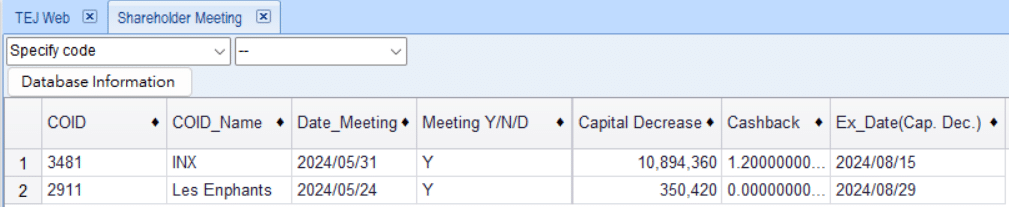
INNOLUX CORPORATION (3481) held its shareholders’ meeting on May 31, 2024, where the proposal for a cash capital reduction was approved. After the meeting, the company followed the required procedures and disclosed key information on the Market Observation Post System.
2024/7/10 : The company announced the capital reduction record date and share conversion plan. The capital was reduced by NT$10.89 billion, with a 12% reduction ratio. Each share returned NT$1.2 in cash.
Les enphants Co.,Ltd. (2911) held its shareholders’ meeting on May 24, 2024, where the proposal for capital reduction to offset losses was approved. After the meeting, the company proceeded with the required procedures and disclosed key information on the Market Observation Post System.
2024/8/1 : The company announced the capital reduction record date and share conversion plan. The capital was reduced by NT$350.42 million, with a 25% reduction ratio.
The complete capital reduction announcements are recorded in TEJ’s corporate action database:
TEJ’s Shareholders’ Meeting database provides dividend policy information approved at each shareholders’ meeting. It also aggregates the annual dividend amount, making it easier to compare dividend policies across periods or companies.
For example, the figure below shows TSMC (2330) and its quarterly cash dividends for 2024. In the fourth quarter, TSMC distributed NT$4.5 per share, with the ex-dividend date on June 12, 2025. For the 2024 shareholders’ meeting year, the accumulated cash dividend reached NT$16.99977526 per share.

In 2024, listed OTC companies released over 76,000 material information announcements on the Market Observation Post System, with more than 41,000 published during the peak shareholders’ meeting season in the first half of the year. TEJ filters, classifies, and organizes these announcements daily, transforming them into practical information for investors.
TEJ’s Shareholders’ Meeting database helps investors efficiently track shareholders’ meeting resolutions, dividend policies, and market developments. It also provides structured data for quantitative investment, event-driven trading, and corporate governance analysis, enabling investors to identify opportunities and make more informed decisions.