
TESG Ratings Reveal the Full Launch of Disclosure: Sustainability Information Quality Becomes a New Battleground for Enterprises
In 2025, Taiwanese companies are officially entering the era of comprehensive sustainability disclosure. Taiwan Economic Journal (TEJ) released the latest TESG Ratings November 3, revealing significant changes in the completeness, accuracy, and alignment with international standards of corporate disclosures. With the adoption of the new GRI Standards, biodiversity-related issues, and SASB industry-specific indicators, corporate sustainability disclosure is no longer merely about “responding to disclosure requirements,” but has become a key indicator of competitiveness.
In this round of ratings, a total of 559 companies were upgraded, while 618 companies were downgraded. The increasing transparency of sustainability information is reshaping the distribution of ratings and reflecting that the depth and credibility of corporate ESG (Environmental, Social, and Governance) disclosures are becoming new focal points of competition.
TESG Ratings Insights: All Listed and OTC Companies Brought Under Disclosure Requirements, Facing New Regulatory Challenges
Following the amendment of the Regulations Governing the Preparation and Filing of Sustainability Reports in May 2025, sustainability report disclosure requirements have officially been expanded to all listed and OTC companies. According to statistics from the TEJ–TESG Sustainability Dataset, as of the end of September 2025, a total of 1,964 companies had disclosed their 2024 sustainability reports. Among them, 1,890 were listed and OTC companies, while the remaining 74 were emerging stock and public offering companies.
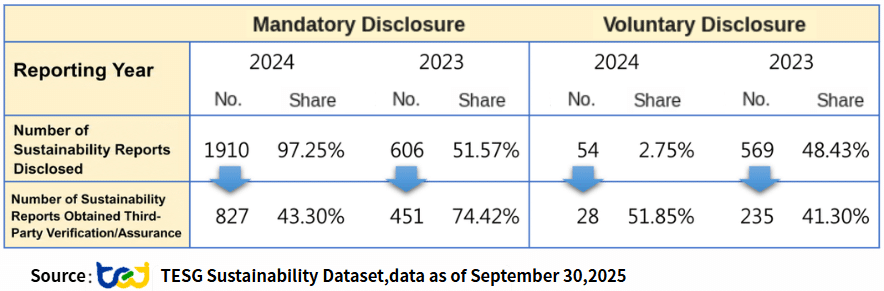
After comprehensive disclosure requirements were introduced, disclosure quality has become a new challenge for enterprises. Certain disclosure items in sustainability reports must be verified or assured by third parties. Among companies subject to mandatory disclosure for the 2023 reporting year, 451 obtained third-party verification, accounting for 74.42%. By the 2024 reporting year, as all listed and OTC companies were required to disclose, the number of verified companies increased to 827; however, the share dropped to 43.30%, indicating that newly included companies are still in an adjustment period. Going forward, the focus of sustainability information will shift from “disclosure coverage” to deeper “disclosure quality,” emphasizing the credibility, specificity, and comparability of information.
Overview of Sustainability Report Verification and Assurance in the Past Two Years
Significant Improvement in Report Disclosure Performance: 21 Companies See Sharp TESG Rating Upgrades
This round of TESG Ratings mainly uses 2024 sustainability reports and publicly available information as the basis for evaluation, covering 2,527 companies, an increase of 47 from the previous period. As regulations continue to promote higher levels of disclosure, information transparency has also become a driver of corporate competitiveness. In particular, 21 companies that published sustainability reports for the first time, followed the GRI Standards, and obtained third-party verification or assurance saw their average ratings rise by 2 to 3 levels, demonstrating the significant impact of report quality on ratings.
TESG Ratings is Taiwan’s first ESG indicator authorized by SASB to comprehensively evaluate listed, OTC, and public offering companies in Taiwan. Through more than 70 variables, it quantifies corporate performance and covers 16 sustainability issues. TESG Ratings not only reflect a company’s performance in ESG (Environmental, Social, and Governance), but also serve as a key reference for investors and financial institutions when assessing future potential.
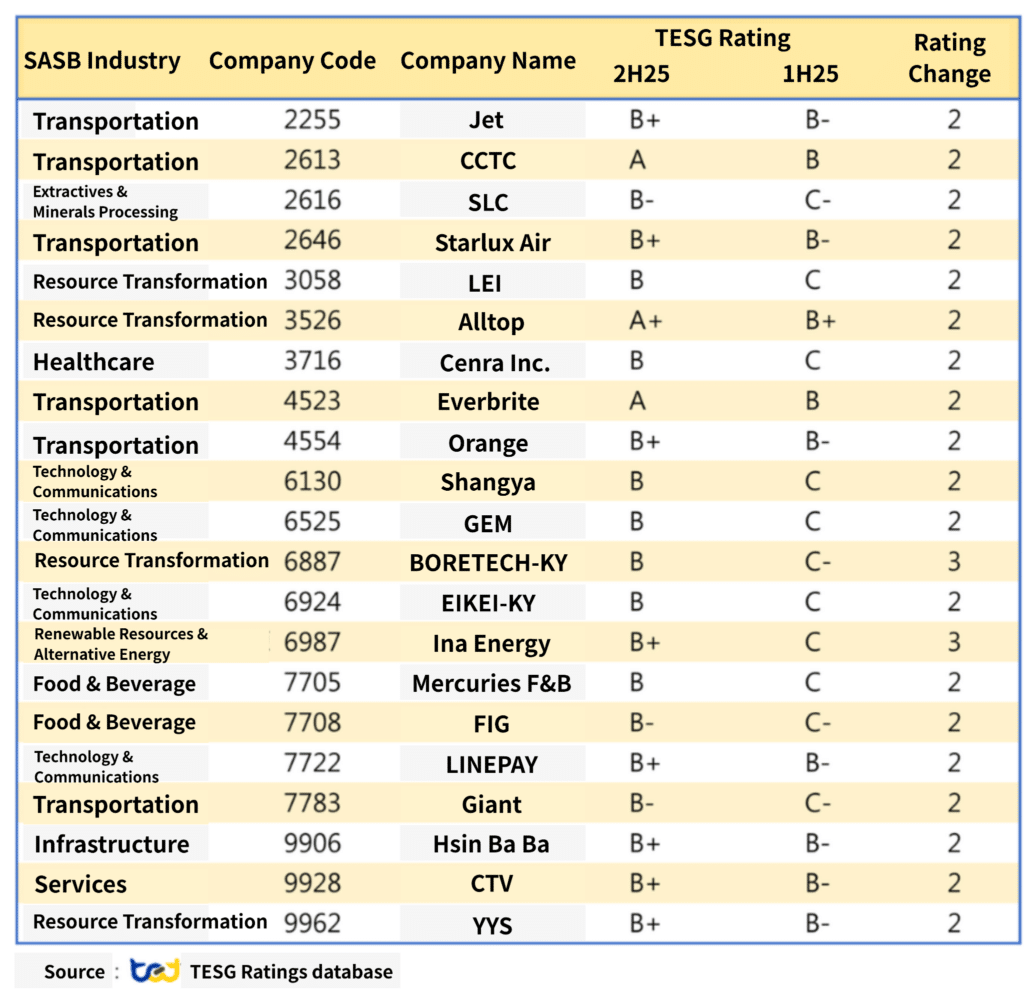
Companies That Published 2024 Sustainability Reports for the First Time, Followed the GRI Standards, and Obtained Third-Party Verification or Assurance
Aligning with International Standards: Dual Disclosure from GRI to SASB
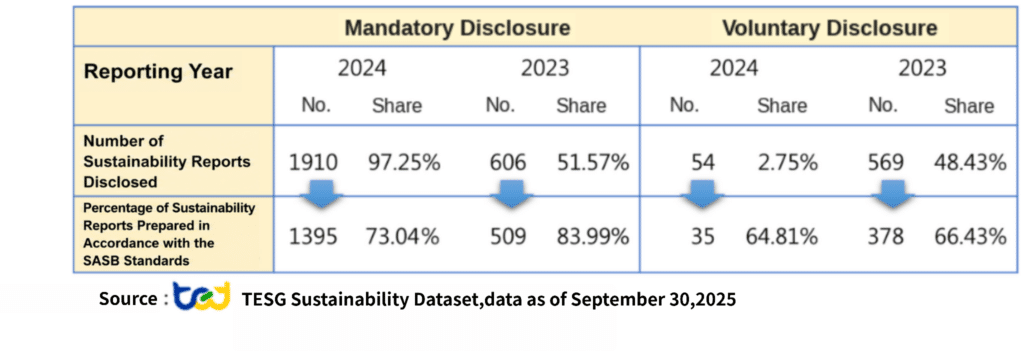
At the end of 2020, the FSC introduced the“Corporate Governance 3.0 — Sustainable Development Roadmap”, encouraging companies to refer not only to the GRI Standards, but also to incorporate SASB industry-specific indicators to strengthen the industry relevance of sustainability issues. To align with the 2024 version of the IFRS Sustainability Disclosure Standards, the revised Regulations Governing the Preparation and Filing of Sustainability Reports encourage the disclosure of SASB industry information to improve disclosure quality and comparability. In the 2024 reporting year, 73.04% of companies subject to mandatory disclosure followed the SASB Standards, reflecting that SASB has gradually been internalized as an important framework for corporate sustainability disclosure and has become one of the key bases for deepening sustainability reports in Taiwan.
Overview of Sustainability Reports Prepared in Accordance with the SASB Standards in Recent Periods
TEJ Supports Companies in Deepening Sustainability Disclosure and Moving Toward International Alignment
TEJ has been deeply engaged in ESG data for many years. In addition to launching the TESG Ratings and the TESG Sustainability Dataset, TEJ continues to track the latest international standards, including GRI 2024 biodiversity disclosures and the IFRS Sustainability Disclosure Standards. To help companies respond to nature-related issues in advance, TEJ has introduced the TNFD Nature-related Entity Risk Rating, assisting companies in understanding operational site and ecosystem hotspot overlapping risks and transforming nature-related risks into concrete decision-making references.
TEJ’s sustainability solutions integrate one-stop support from information disclosure and risk analysis to decision-making applications, helping companies and financial institutions enhance sustainability resilience and move toward a new stage of international alignment.